EC Number   |
Substrates |
Products |
Reversibility  |
|---|
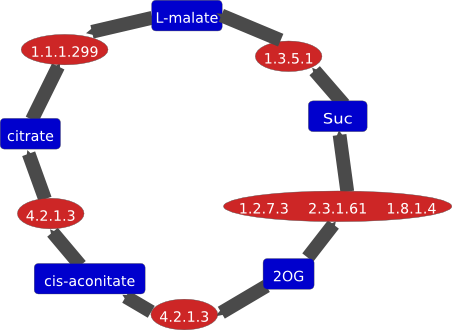    3.5.1.54 | more |
the catalytic reaction is catalyzed by either the full-length AtzF or the amidase domain of AtzF, AtzF467. There is no catalytic advantage conferred by the C terminus of AtzF in vitro |
? |
- |
? |
| 3.5.1.54 | more |
binding process of allophanate to allophanate hydrolase, computational analysis, enzyme-substrate interaction, overview |
? |
- |
? |
| 3.5.1.54 | urea-1-carboxylate + H2O |
- |
2 CO2 + 2 NH3 |
- |
? |
| 3.5.1.54 | allophanate + H2O |
- |
CO2 + NH3 |
- |
ir |
| 3.5.1.54 | allophanate + H2O |
2nd step in the degradation of urea |
CO2 + NH3 |
- |
ir |
| 3.5.1.54 | allophanate + H2O |
the enzyme is involved in bacterial cyanuric acid metabolism |
NH3 + CO2 |
- |
ir |
| 3.5.1.54 | allophanate + H2O |
- |
NH3 + CO2 |
- |
ir |
| 3.5.1.54 | allophanate + H2O |
the enzyme forms an alternative urea degradation pathway with the urea carboxylase, EC 6.3.4.6 |
NH3 + CO2 |
- |
ir |
| 3.5.1.54 | allophanate + H2O |
the reverse reaction is catalyzed by urea carboxylase |
2 CO2 + 2 NH3 |
- |
ir |
| 3.5.1.54 | allophanate + H2O |
- |
2 CO2 + 2 NH3 |
- |
ir |